

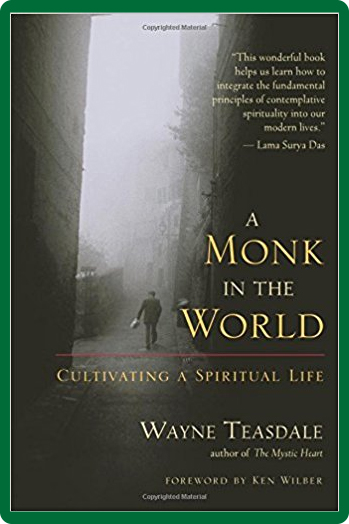
It was in reading the book The New Monasticism: An Interspiritual Manifesto for Contemplative Living that I discovered Wayne Teasdale. I have encountered this mysterious and seductive monastic voice in my readings of other monks, men and women, contemplatives and mystics. Years ago, I recognized this voice when reading Howard Thurman’s, Meditations of the Heart.
In one of the chapters, Thurman, a theologian and advocate of radical, non-violence, described how he searched his soul when he encountered a mouse in the basement of the house that he was soon to vacate. He said that he could find no reason other than it would have been dishonest to leave the mouse in the basement to be discovered by the new owners. As such, he felt compelled to kill it. I remember that it was that chapter, not the ones that linked his spiritual practice to the Civil Rights Movement, which further aroused my interest in the life of the contemplative/mystic.
Much unlike Thurman’s book, Teasdale’s offers advice from his experience on the process of creating a monastic/contemplative practice beyond monastery walls. I was anxious to find out what counsel this writer, advocate for the homeless and former professor at DePaul University, Chicago, Illinois, offered to those of us who have long felt the call to the monastic/contemplative life.
It is a ten chaptered book, not all of which I found of interest. The chapter on “Tough Grace: A Contemplative Understanding of Suffering,” I did not bother to read because I have always had issues, since my experience in the Baptist Church, why a God of love would ask Its creation to suffer; and “The Epilogue: Toward a New Catholicity,” I passed over also because I am not a Catholic and have no interest in the reformation of Catholic practice.
In other chapters, Teasdale’s revelations about the challenges of establishing a daily practice were immeasurably valuable. He speaks of his disappointments and frustrations with meditation and mindfulness. He says that because he was a professor, whose profession it is to “think,” he had challenges with calming what the Buddhists call the “monkey mind.” Thomas Merton, also, remarks often in his writings on the contemplative life that some challenges are universal, occurring in and outside of the monastery. After some practice and persistence, Teasdale writes, he was able to look forward to daily meditation periods, periods which he suggests, should be commonplace in the life of the contemplative/monastic.
Chapter 5, “Keeping Our World in Order: The Preciousness of Time, the Sacredness of Work, and the Use of Money,” intimately speaks to my experience. I didn’t think there was anyone who has wasted as much time as I have, but Teasdale says otherwise. He comments that as we near the end of our earthly sojourn (near to croaking), it is precisely because of our squandering of time that we realize its preciousness, its gift, and its divine nature. In this chapter, he outlines how he spends his days, and the abundance that comes of living the simplicity of the monastic life.
His conversation on work and the value of work was extremely insightful and I will be using some of those insights in my call for the transformation of work and work life. I’ve also implemented some of his teachings about the salvific aspect of “our calling” and “vocation” into my experience. In short, our vocational calling is that which keeps us engaged and in communication with the Divine realm. It is what the Divine, through us, wants to express, gift and share with the world.
Chapter 7, “Dancing on the Edge: The Struggle to Promote Change,” was especially informative because it links spiritual practice to social justice. Teasdale writes that the contemplative life must not be relegated to the margins of society, but brought to the suffering and the marginalized, even unto the very structures of political systems that are often the source of much of the suffering in the world. He was a radical advocate for the homeless in Chicago, Illinois.
Teasdale shares his reasons for leaving the traditional monastery, and how, based on his experience being a monk in the world, we, too, can co-create a new paradigm for what it means to be a contemplative/monastic. I had no idea until I read Teasdale and the The New Monasticism: An Interspiritual Manifesto that there were communities who were practicing a new form of monasticism. This new practice seems to be one where social activism plays as much of an important role in the life of the monastic, as does prayer and the reading of the scriptures in the lives of those who reside within the monastery walls.
A Monk in the World is guidance from a monk who exited the monastery to establish a monastic practice in the heart of a bustling, urban and challenging city, Chicago, Illinois. Teasdale has created some guidelines for the new monastic. The call to the monastic life beyond the walls of the monastery is not without its challenges. The new monastic must respond to the absence of the abbot, the absence of the call to prayer and a supportive community of like-minded spirits. This is the call to a commitment to become the observation of a new paradigm of spiritual transformation in the world.
Suggested videos on the new monasticism:
https://www.youtube.com/watch?v=L61o34CCmmo
https://www.youtube.com/watch?v=cP67SxLk1_4
I’ve got Derrick Jensen’s book, The Myth of Human Supremacy, up for review in the next edition, June, 2017
